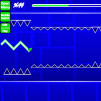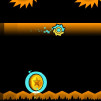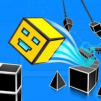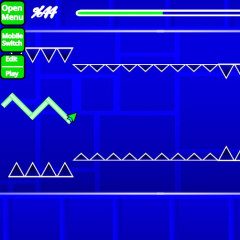
Big Tower Tiny Square 2 is a fast-paced platforming game that offers a new challenge. Guide Tiny Square to the top of a massive tower to rescue a pineapple.
The tower itself is the main challenge. Instead of offering a straightforward path upward, each section introduces obstacles that can stop your progress if you move without paying attention. You need to carefully navigate around lava pits, movement detection lasers, spinning spikes, and other hazards. Some obstacles require precise timing, while others demand that you understand their movement pattern before attempting to pass. The game also includes other Tiny Squares who provide hints during your journey. Their advice can help you understand what to expect as you enter unfamiliar sections of the tower. Besides, you can play Stickman Hook and Flappy Bird, which are other interesting adventure games.
The story continues the strange rivalry between Big Square, Tiny Square, and Pineapple. After a pineapple clone is destroyed in the Big Flappy Tower, Big Square returns to the original Big Tower. Instead of leaving the past behind, he steals another pineapple and rebuilds the tower's ruins. The rebuilt tower combines traps from earlier adventures with additional dangers, creating a new obstacle course for Tiny Square. Your role is to climb through this rebuilt structure and rescue Pineapple. The story gives the platforming challenge a clear purpose. You are not simply climbing because the game tells you to reach the top. You are climbing because Pineapple needs to be rescued, and Big Square needs to be stopped.
The controls and overall concept are straightforward, but completing the tower requires concentration. Your primary task is to move Tiny Square upward while avoiding anything that can cause you to die. Each new section can introduce a different arrangement of hazards, so you should avoid assuming that the same approach will work everywhere. Instead, take a moment to observe the environment and determine the safest route.
Speed is useful, but reckless movement can quickly end a run. When you enter a new part of the tower, look for hazards before moving forward. A lava pit may block the obvious route, while a laser can activate when you enter its detection range. Spinning spikes can also make an otherwise simple jump much more difficult. Approach each obstacle according to its behavior. If a hazard moves in a predictable pattern, watch it for a moment and time your movement accordingly. If you rush forward without understanding the timing, you may repeatedly hit the same obstacle. The game rewards patience as much as quick reactions.
Dying is part of the experience in Big Tower Tiny Square 2. The tower is designed to test your ability to recognize hazards and adjust your timing. A failed jump tells you something about the obstacle ahead. Perhaps you moved too early, waited too long, or approached from the wrong position. Instead of repeating the same movement, use each attempt to refine your approach. The frequent checkpoints make this process much more manageable. You can retry difficult sections without losing all of the progress you made before reaching the checkpoint.
The tower contains a mixture of returning hazards and new challenges. Some obstacles are immediately recognizable, while others require you to observe their behavior before making your move. The most important hazards mentioned in the game include lava pits, movement detection lasers, and spinning spikes.
Lava pits are among the most straightforward hazards in the tower, but that does not make them harmless. You need to judge your jumps carefully when crossing gaps filled with lava. A jump that looks easy can become dangerous if you misjudge the distance or land too close to the edge. Before jumping over lava, consider the space available on the other side. You should aim for a stable landing rather than simply trying to clear the gap. If there is another obstacle immediately after the landing area, you may also need to prepare for your next movement before making the jump. This becomes more important as the tower introduces combinations of obstacles. A successful lava jump is only useful if you can safely handle whatever comes next.
Lasers add another layer of timing to the platforming challenge. Unlike a stationary obstacle, a movement detection laser can punish you for entering its range at the wrong moment. You therefore need to pay attention to the laser's position and determine when it is safe to move. When you encounter a laser section, avoid immediately rushing through it. Take a moment to understand how the detection system works. Watch for a safe opening and move when the path is clear. The challenge is often less about speed and more about choosing the right moment. Once you understand the pattern, you can make your move confidently. If you fail, the nearby checkpoint means you can quickly try again.
Spinning spikes are another major threat inside the rebuilt tower. Their movement makes them harder to approach than simple stationary obstacles. You need to consider both your position and the timing of the spinning hazard. The safest way to handle spinning spikes is to watch their movement and identify a gap. Do not assume that moving quickly will automatically get you through. A poorly timed jump can put Tiny Square directly in the path of a spike. Wait for the right opening, then move decisively. This combination of observation and execution is one of the core skills you develop while climbing the Big Tower.
The game's mechanics are easy to understand, but mastering the tower requires practice. A few simple habits can make your climb more consistent.
Some parts of the tower may initially seem impossible. That feeling usually changes once you understand the obstacle's timing. Instead of trying to force your way through, break the section into smaller steps. Ask yourself:
Answering these questions can turn a frustrating section into a manageable sequence of movements.
Fast platforming does not always mean holding the controls continuously. Sometimes the safest strategy is to stop, observe, and then make one precise movement. Other sections may require quick consecutive actions.