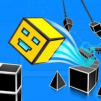
Bloxorz is an engaging puzzle game with stunning 3D graphics. You must guide a block through a stage and make it fall into the square hole at the end.
At the start of each stage, the block is positioned on a map made of tiles. Movement is controlled using the arrow keys, and each press causes the block to shift one square in the chosen direction. One of the most important skills in Bloxorz is understanding the block's orientation:
This means you are not simply walking from place to place. Instead, every move changes the block's position and potentially its orientation, which can affect whether the block can safely cross gaps, press switches, or avoid traps.
Each stage ends when you successfully guide the block so it falls into the hole. This typically requires careful planning of the last few moves, because the hole is reachable only through specific alignments. A common mistake is being close to the goal but approaching the hole in the wrong orientation. When this happens, the block might fall short, hit an edge, or fail to drop into place. Another fundamental part of winning is learning not to fall off the edges. If the block goes beyond the map boundaries, the stage restarts. Because restarting wastes time and resets progress, you should always check upcoming moves and confirm that the block is positioned to remain fully on solid ground.
How to control: Arrow Keys = Move the block.
Many levels include bridges and switches, which are used to create or block routes. Bridges often have to be opened at the right moment, so the switch mechanisms become part of the puzzle strategy rather than simple obstacles. Switches are activated when the block presses them down, and the behavior depends on the type of switch:
Not all switches simply open the bridge permanently. Some switches may:
To succeed, you must observe what each switch does during the stage. You should watch for green or red flashing squares, which indicate which bridges are being operated. This visual feedback is essential for planning future moves, since stepping on the wrong switch at the wrong time could trap the block on the wrong side of a bridge.
In addition to switches and bridges, the environment includes orange tiles, which are more fragile than the rest of the land. These tiles can cause instant failure if handled incorrectly. If the block stands upright vertically on an orange tile, the tile will give way, and the block will fall. This means that you must treat orange tiles as hazards that are safe only when the block is not upright on them. In practice, winning strategies often involve: